MatForge - Advanced Material Rendering System
Overview
MatForge is an advanced material rendering system that implements FOUR complementary SIGGRAPH papers (2023-2024) in a unified Vulkan ray tracing pipeline. Our goal is to create a production-quality material authoring and rendering workflow that combines state-of-the-art techniques for sampling, geometry, and shading.
Project Context
- Course: CIS 5650 GPU Programming and Architecture
- Semester: Fall 2025
- Institution: University of Pennsylvania
- Team: 3 Students (Yiding Liu, Cecilia Chen, Xiaonan Pan)
- Timeline: November 3 - December 7, 2025 (5 weeks)
- Platform: Vulkan 1.3 with ray tracing extensions
- Base Framework: Forked from NVIDIA nvpro-samples/vk_gltf_renderer
Features
Rendering Pipeline Architecture
┌─────────────────────────────────────────────────────┐
│              MatForge Rendering Pipeline            │
├─────────────────────────────────────────────────────┤
│                                                     │
│  1. QOLDS - Sampling Foundation                     │
│     └─ Generate low-discrepancy random numbers      │
│        ↓                                            │
│  2. RMIP - Geometry Detail                          │
│     └─ Ray-trace displacement maps directly         │
│        ↓                                            │
│  3. Bounded VNDF - Direction Sampling               │
│     └─ Efficient importance sampling                │
│        ↓                                            │
│  4. Fast-MSX - BRDF Evaluation                      │
│     └─ Multiple scattering approximation            │
│        ↓                                            │
│  5. MONTE CARLO INTEGRATION                         │
│     └─ Combine: f(ωᵢ, ωₒ) × L(ωₒ) × cos(θ) / PDF    │
│                                                     │
└─────────────────────────────────────────────────────┘
Implemented Techniques
✅ Quad-Optimized Low-Discrepancy Sequences (QOLDS)
Paper: Ostromoukhov et al., ACM SIGGRAPH 2024 Status: Complete
- Base-3 Sobol’ sequences with (1,4)-sequence property
- Owen scrambling for randomization
- 15-30% variance reduction vs. standard sampling
- Negligible performance overhead
- 47 dimensions × 243 max points (3^5)
Benefits: Foundation layer providing better random samples for all Monte Carlo integration tasks.
✅ Fast Multiple Scattering Approximation (Fast-MSX)
Paper: ACM SIGGRAPH 2023 Status: Complete
- Relaxed V-cavity model for GGX materials
- Modified distribution and geometry terms
- Additive multi-scatter BRDF term
- 100× better energy conservation at high roughness
- ~5% performance overhead
Benefits: Fixes dark edges on rough materials, improves physical accuracy of GGX BRDF.
🚧 RMIP (Rectangular MinMax Image Pyramid)
Paper: Thonat et al., ACM SIGGRAPH Asia 2023 Status: In Progress (GPU data structure complete, ray tracing integration underway)
- Tessellation-free displacement ray tracing
- Hierarchical min-max pyramid for oblong bounding
- Inverse mapping: ray ↔ texture space
- 11× faster than TFDM, 3× less memory than tessellation
Benefits: Add high-frequency geometric detail without mesh complexity.
📋 Bounded VNDF Sampling
Paper: Eto & Tokuyoshi (AMD), ACM SIGGRAPH Asia 2023 Status: Planned for Milestone 2
- Tighter spherical cap bound for GGX sampling
- 15-40% variance reduction for rough surfaces (α = 0.6-1.0)
- Minimal overhead (<1%)
Benefits: Fewer rejected samples for rough materials, faster convergence.
Gallery
Milestone 1 Progress
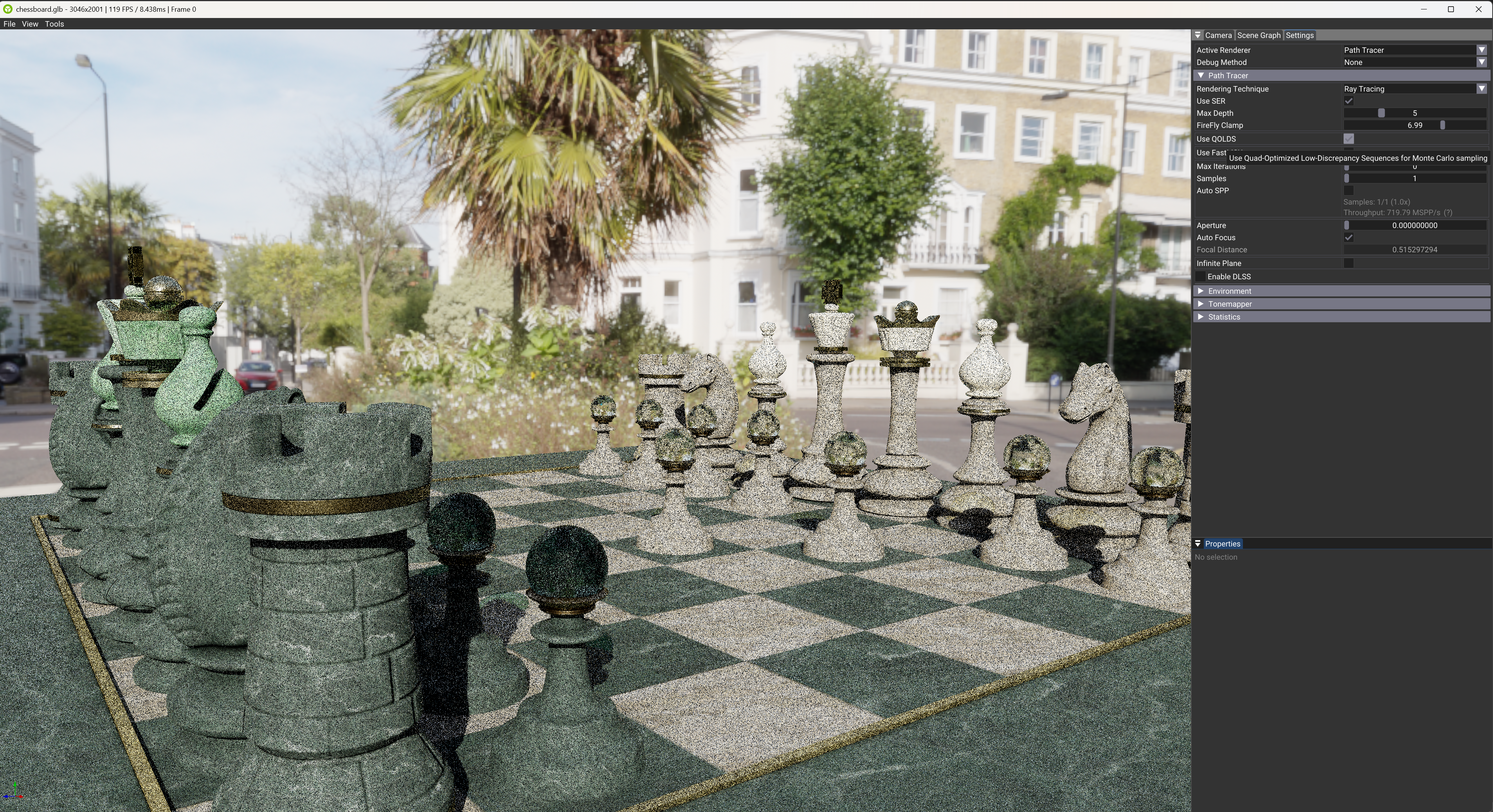
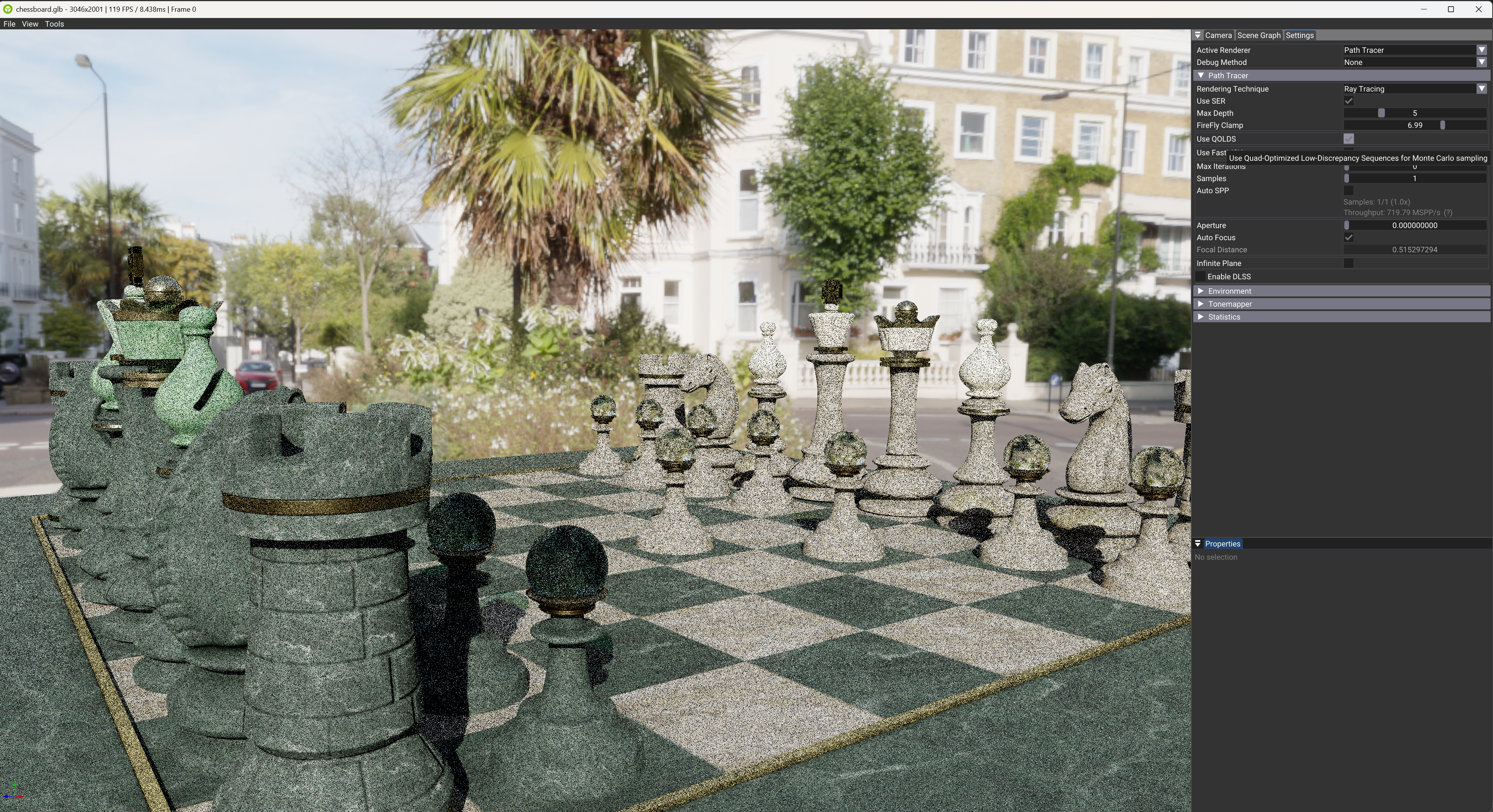 QOLDS sampling integration with GUI toggle and console logging
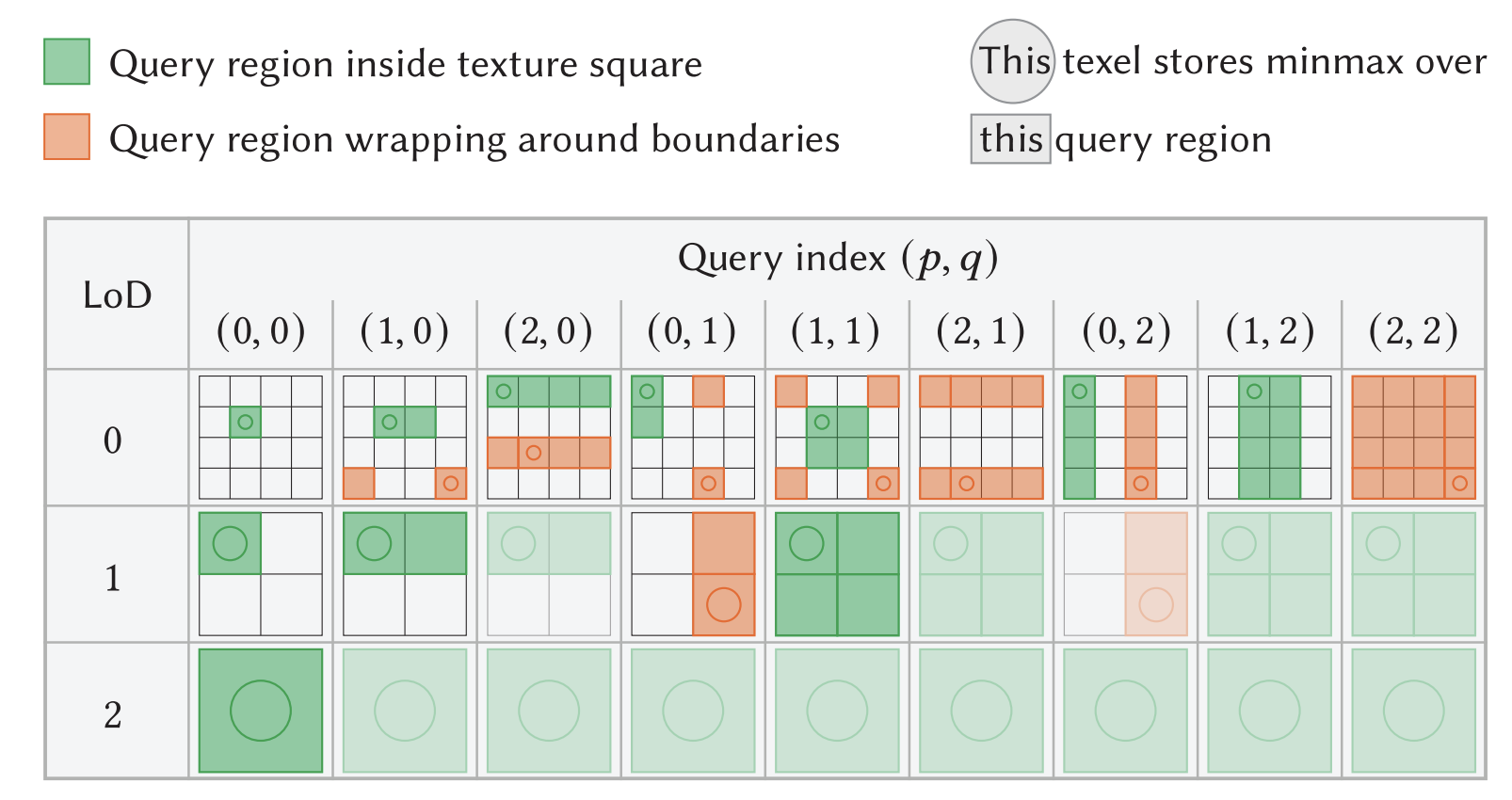 RMIP hierarchical min-max pyramid structure
 Fast-MSX multi-scattering approximation improving energy conservation
Team
| Team Member | Role | Technique | Status |
|---|---|---|---|
| Yiding Tian | Sampling Specialist | Quad-Optimized LDS | ✅ Complete |
| Cecilia Chen | Geometry Specialist | RMIP Displacement | 🚧 In Progress |
| Xiaonan Pan | Material Specialist | Fast-MSX + Bounded VNDF | ✅ Fast-MSX Complete |
Milestones
Milestone 1: November 12, 2025 ✅
Goal: Individual techniques working (foundations)
Achievements:
- ✅ QOLDS fully integrated (700 LOC)
- ✅ RMIP GPU data structure builder (800 LOC)
- ✅ Fast-MSX implementation (350 LOC)
- ✅ Total: ~1,850 lines of production code
Milestone 2: November 24, 2025 🎯
Goal: Full pipeline integration + material system
Target Deliverables:
- Complete RMIP ray tracing integration
- Bounded VNDF implementation
- Material library (7+ materials)
- Performance benchmarks
- Comparison modes (toggle each technique)
Final Presentation: December 7, 2025 📅
Goal: Production features + comprehensive analysis
Final Deliverables:
- Complete 4-technique pipeline
- Material parameter editor
- Demo video
- Technical documentation
- Performance analysis
Documentation
Quick Links
- GitHub Repository
- README.md - Quick start and build instructions
- Milestone 1 Report
Papers
- Quad-Optimized LDS: Ostromoukhov et al., “Quad-Optimized Low-Discrepancy Sequences”, ACM SIGGRAPH 2024
- RMIP: Thonat et al., “Displacement ray-tracing via inversion and oblong bounding”, ACM SIGGRAPH Asia 2023
- Bounded VNDF: Eto & Tokuyoshi, “Bounded VNDF Sampling for Smith-GGX Reflections”, ACM SIGGRAPH Asia 2023
- Fast-MSX: “Fast Multiple Scattering Approximation”, ACM SIGGRAPH 2023
Performance Targets
| Resolution | Quality | Target FPS | Hardware |
|---|---|---|---|
| 1080p | Interactive | 60 | RTX 4070 |
| 1080p | Balanced | 30 | RTX 4070 |
| 1440p | Quality | 20 | RTX 4070 |
Expected Improvements:
- QOLDS: 15-30% variance reduction
- RMIP: 11× faster than tessellation
- Bounded VNDF: 15-40% fewer rejected samples
- Fast-MSX: 100× energy conservation improvement
Build Instructions
Quick Start
# Clone repository
git clone https://github.com/matforge/MatForge.git
cd MatForge

# Configure and build (Windows)
cmake -B build -S . -DUSE_DLSS=ON
cmake --build build --config Release

# Run
.\_bin\Release\vk_gltf_renderer.exe
Requirements:
- Windows 10/11
- NVIDIA RTX GPU (RTX 20-series or newer)
- Vulkan SDK 1.3+
- CMake 3.25+
- C++20 compiler (MSVC 2022 / GCC 11+)
For detailed build instructions, see README.md.
Acknowledgments
- Instructor: Shehzan Mohammed (University of Pennsylvania)
- Base Framework: NVIDIA nvpro-samples
- Papers: SIGGRAPH 2023-2024 authors
- Course: CIS 5650 GPU Programming
Contact
- GitHub: matforge/MatForge
- Course Forum: Ed Discussion
- LinkedIn: CIS 5650 Alumni Group
Last Updated: November 18, 2025